


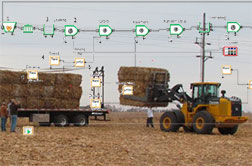
Stable, functional, and efficient bioethanol production systems on the national level must emphasize solutions of feedstock availability and transportation problems. Transportation logistics are a critical factor in the optimization of biomass supply chains. A single 25 million gallon per year cellulosic ethanol biorefinery will require delivery of 18,500 semi loads of bales to the plant. For a typical corn-stover biomass supply chain, baled corn stover must be transported in two phases, first from the field to a storage site and then from the storage site to the biorefinery. All activities between these two points are interconnected and together they form the biomass supply chain. The goal of supply-chain optimization is to minimize the total cost of these activities (transportation cost per unit, inventory cost per unit etc.) while satisfying the supply demands of a biorefinery.
A model of the supply-chain representing a realistic biomass transportation cycle between a single cornfield and biomass storage was created in ExtendSim. The supply-chain model was a representation of a realistic biomass transportation cycle between a single cornfield and biomass storage, including multiple simulations using different model factors.