
A wave of significant change is moving through the consumer packaged goods (CPG) industry redefining how companies grow, operate, and manage risk. Energy and raw material costs are on the rise, nutritional requirements are constantly changing, increased competition is lowering profit margins - so how do you improve efficiencies in production and distribution to gain an advantage?

The manufacturing process is complex - managing equipment design, plant layout, optimal mix/cook cycle, product packaging, transportation of end product, etc. On top of that, CPG manufacturers are confronted with numerous risk and regulatory issues that government and other regulatory bodies are putting into place. What do you do?

This might be the one time you want to follow the crowd and use ExtendSim.
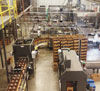
distribution-center

Distri­bution Center

A distribution center for a brewery industry leader was fully designed using simulation as a support decision tool. The simulation model took into account all the tasks performed by the distribution...

read more

food-processing

Food Processing

For decades, Procter & Gamble has been using ExtendSim to develop and maintain a reliable formula for the relationship between the moisture content of peanuts and the time needed to roast the...

read more

packaging-line

Packaging Line

A popular cookie producer models their packaging line to understand the dynamics and capacity of their system. Their model shows the effect of changing the speed of a piece of equipment, the failure...

read more

production-requirements

Production Require­ments

A thermo processed meat producer tried to determine the production requirements, in terms of number of ovens and cooling plates it would be required for the production of a certain volume of...

read more

ExtendSim in Consumer Packaged Goods

  • Food and beverage manufacturing facilities.
  • High volume, high speed flow operations.
  • Sustainability and traceability.
  • Risk assessment and food safety.
  • Inventory management.
  • Production planning and scheduling.
  • Supply and cold chain management.
  • Packaging and bottling operations.
  • Optimizing perishable and substitutable inventory management systems.

ExtendSim in Consumer Packaged Goods

  • Food and beverage manufacturing facilities.
  • High volume, high speed flow operations.
  • Sustainability and traceability.
  • Risk assessment and food safety.
  • Inventory management.
  • Production planning and scheduling.
  • Supply and cold chain management.
  • Packaging and bottling operations.
  • Optimizing perishable and substitutable inventory management systems.

Who is using ExtendSim in Consumer Packaged Goods

  • Over-utilized inventory locations at one of its grocery products facilities was causing problems with Hormel Foods' product flow. Product mix and number of supply items had grown creating an imbalance in storage locations for the inventory. Inputing data from a sampling of time, they used ExtendSim to model the different systems that were supplying and demanding material from bay locations at various rates, quantities, and shifts of operation. Hormel was able to determine the best alternative solution while verifying adequate inventory turns, minimizing equipment and material handling costs, and meeting capacity requirements.
  • An international manufacturer of heavy duty mining equipment built a custom library of blocks in ExtendSim. Each block represented a different piece of their rock crushing equipment. Their sales team was able to bring this tool to a customer site and build a model of the customer's entire crushing and screening process on the spot. They were quickly and easily able to create a technically and economically optimized solution for each customer's actual combination of feed material and operating conditions.
  • The complexity of truck loading was approached with the support of a simulation model by a beverage distribution company. Among the variables comprised to achieve shorter cycle time were the modification of the truck schedules and the amount of docks needed for each vehicle category.
  • For one of the pioneers in 3rd-party agrarian services, ExtendSim was used to approach the operation of temporary grain storage in “silo bags” during the crop harvest. Simulation was used to assess the requirements of process design, equipment, and investment decisions. Plus, it helped the agrarian service experts explore options of operative modes to optimize the deployment of resources in this critical instance during the harvest.
  • For a company focused in beverage distribution, simulation was used to calculate the size and profile of a fleet of trucks to serve retailers and supermarkets in the different areas of the Federal District. Among the more important requirements to be considered were: the capacity of the trucks, the maximum number of contacts in a route, the daily activity level - measured by the number of clients and the quantity requested by each client, and legal restrictions as the loading and unloading schedule allowed by the city. Simulation allowed them to find the optimal quantity of trucks to own, the quantity of hired trips, and the bundles transported by them (since it was paid by bundle and not for hired trip), and the prospective utilization level of the fleet.
  • ConAgra Foods reached out to the University of Idaho asking them to partner with them on a process improvement project. Since ConAgra is a heavy ExtendSim shop, they requested student teams use ExtendSim. Students were asked to evaluate the cost and effectiveness of in process inspection vs. end of process inspection in systems where the variation is often due to product mix, mean time to down times, and duration of down times instead of variation within the actual processing time.
  • Major beverage retailer simulates product demand to optimize staffing levels at retail locations worldwide.
  • Procter & Gamble uses ExtendSim to model everything from soup to nuts.

Who is using ExtendSim in Consumer Packaged Goods

  • Over-utilized inventory locations at one of its grocery products facilities was causing problems with Hormel Foods' product flow. Product mix and number of supply items had grown creating an imbalance in storage locations for the inventory. Inputing data from a sampling of time, they used ExtendSim to model the different systems that were supplying and demanding material from bay locations at various rates, quantities, and shifts of operation. Hormel was able to determine the best alternative solution while verifying adequate inventory turns, minimizing equipment and material handling costs, and meeting capacity requirements.
  • An international manufacturer of heavy duty mining equipment built a custom library of blocks in ExtendSim. Each block represented a different piece of their rock crushing equipment. Their sales team was able to bring this tool to a customer site and build a model of the customer's entire crushing and screening process on the spot. They were quickly and easily able to create a technically and economically optimized solution for each customer's actual combination of feed material and operating conditions.
  • The complexity of truck loading was approached with the support of a simulation model by a beverage distribution company. Among the variables comprised to achieve shorter cycle time were the modification of the truck schedules and the amount of docks needed for each vehicle category.
  • For one of the pioneers in 3rd-party agrarian services, ExtendSim was used to approach the operation of temporary grain storage in “silo bags” during the crop harvest. Simulation was used to assess the requirements of process design, equipment, and investment decisions. Plus, it helped the agrarian service experts explore options of operative modes to optimize the deployment of resources in this critical instance during the harvest.
  • For a company focused in beverage distribution, simulation was used to calculate the size and profile of a fleet of trucks to serve retailers and supermarkets in the different areas of the Federal District. Among the more important requirements to be considered were: the capacity of the trucks, the maximum number of contacts in a route, the daily activity level - measured by the number of clients and the quantity requested by each client, and legal restrictions as the loading and unloading schedule allowed by the city. Simulation allowed them to find the optimal quantity of trucks to own, the quantity of hired trips, and the bundles transported by them (since it was paid by bundle and not for hired trip), and the prospective utilization level of the fleet.
  • ConAgra Foods reached out to the University of Idaho asking them to partner with them on a process improvement project. Since ConAgra is a heavy ExtendSim shop, they requested student teams use ExtendSim. Students were asked to evaluate the cost and effectiveness of in process inspection vs. end of process inspection in systems where the variation is often due to product mix, mean time to down times, and duration of down times instead of variation within the actual processing time.
  • Major beverage retailer simulates product demand to optimize staffing levels at retail locations worldwide.
  • Procter & Gamble uses ExtendSim to model everything from soup to nuts.

Trusted by Leading Consumer Packaged Goods Teams

conagra-foods
hormel-foods
proctor-gamble

Case Studies

The report presents a comprehensive study on implementing Digital Kaizen at a gum and candy manufacturing facility in Egypt, operated by Company X.

Packages that accurately emulate the hybrid processes that characterize food and beverage manufacturing are making simulation more than just a snazzy presentation tool for upper management. Virtual...

A major pharmaceutical company uses ExtendSim to simulate its packaging lines and optimize new line design. The company has gleaned a 30% time reduction in defining new line setup and regulation...

When a non-conformity occurs, the time to recall the produce depends on many factors: lot size, lead time for information spreading from link to link, product transit time among links, product...

Perishability is a huge challenge on the performance of any Agri-food Supply Chain (ASC). The difference between ASC and any other supply chain is the effect of factors like food quality, food...

Pilot experience in the adoption of performance simulation approach to design, redesign, and acquisition of bottling lines for the Zarate plant of Cervecería y Maltería Quilmes S.A. This paper...

Any activity that receives inputs and convert them to outputs can be considered a process. So, essentially, similar equations are used in the theory of chemical, biochemical, nuclear, mechanical,...

Videos

Gray McQuarrie, president of Grayrock & Associates, uses a discrete event model built in ExtendSim to look at issues of dealing with finite plant capacity. He also touches on design of...