


The European railway industry is continuously advancing and in recent years, they have adopted a new system called European Railway Traffic Management System/ European Train Control System (ERTMS/ETCS) for the interoperability of railways among different European nations. Currently, this has been used more extensively for transportation by commuters and for freight. The foremost quality of such transportation system is to operate in a reliable manner and maintain punctuality. In this context, Bane Nor (Norwegian National Rail Administration) is planning to convert the entire conventional signalling system to ERTMS signaling system, as a part of their ERTMS National Implementation project.
ERTMS/ETCS is a complex infrastructure of various systems on trackside, lineside and train onboard and these systems have different sub systems comprising of software, hardware, network and signalling components. Due to its complexity, determining the failures and resolving them is challenging. An existing line operated on ERTMS is taken as case study from Bane NOR for developing a reliability model.
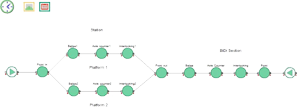
Primarily a reliability block diagram method is used to model the Østfoldbanen Østre Linje (ØØL) ERTMS pilot line as a case study in ExtendSim's Reliability module incorporating a combination of single station and bidirectional (BiDi) sections, then conducting 1000 simulations to assess ØØL ERTMS infrastructure. It is estimated from the results that this model has the potential to determine the performance of the infrastructure, and it is deduced that predominant infrastructure failures that cause delays are due to partial interlocking fail, maintenance and track fracture, followed by failure of balise, axle counters and points.