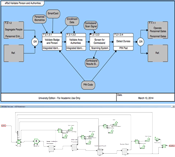

The Navy requires a capability for effective and efficient entry control for restricted areas that house critical assets. This thesis describes an Advanced Restricted Area Entry Control System (ARAECS) to meet this requirement. System requirements were obtained from existing governing documentation as well as stakeholder inputs. A functional architecture was developed and then modeled using the ExtendSim tool. Factors affecting ARAECS operation were binned into physical, technology, Concept of Operations (CONOPS), and noise. An Overall Measure of Effectiveness was developed and a Design of Experiments (DOE) was conducted to measure the affects of these factors on ARAECS performance. The two main drivers were minimizing security violations while also maximizing personnel and vehicle throughput. Based on the modeling, an architecture was selected that best met system objectives—this architecture relied on the ability to pre-screen 40% of the workforce based on security clearance and thus subject them to reduced random screening. The architecture was documented using the Vitech CORE tool, and use cases were developed and documented. A test and evaluation plan was developed and discussed. Risk was then examined, including technical, schedule, and cost risks.

Advanced Restricted Area Entry Control System (ARAECS)
- Source: Naval Postgraduate School
- Date: June 2014