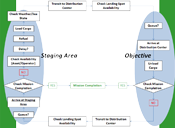

This thesis utilizes the operational context established by Expeditionary Warrior 2010 (EW10), a United States Marine Corps operational level seminar planning game, to analyze a 2022 United States Army Watercraft Foreign Humanitarian Assistance/Disaster Relief (FHA/DR) Operation. The EW10 Wargame was conducted over four days and in order to ensure complete analysis of the entire scenario within the time constraints, the composition of forces was explicitly defined. This thesis considers the full range of possible force compositions. A full functional and physical architecture is developed, using EW10 as an operational basis. Corresponding Measures of Outcome, Measures of Effectiveness, and Measures of Performance for U.S. Army Watercraft FHA/DR Operations are defined. The current U.S. Army Watercraft Master Plan is used to develop a 2022 U.S. Army Watercraft Force Structure, to include the integration of the Office of Naval Research's Transformable Craft (T-Craft). A discrete event simulation is developed using the ExtendSim software to analyze the impact of variations in the projected force structure as well as the performance gains and losses associated with the introduction and removal of the T-Craft from the force structure. Simulation analysis indicates that, if the T-Craft is available in 2022, U.S. Army FHA/DR response forces should be defined by: 8 or more T-Craft, 4 or more Joint High Speed Vessels (JHSVs), and 4 or more Logistics Support Vessels. In the absence of T-Craft, the response force should be defined by: 7 or more JHSVs and 13 or more Landing Craft Utility 2000s.

A Simulation Based Analysis of U.S. Army Watercraft Capabilities in a 2022 Foreign Humanitarian Assistance/Disaster Relief Operation
- Source: Naval Postgraduate School
- Date: 2011