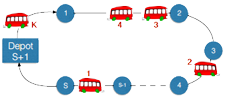

One of the most annoying problems in urban bus operations is bus bunching, which happens when two or more buses arrive at a stop nose to tail. Bus bunching reflects an unreliable service that affects transit operations by increasing passenger-waiting times. This work proposes a linear mathematical programming model that establishes bus holding times at certain stops along a transit corridor to avoid bus bunching. The authors' approach needs real-time input, so a transit corridor is simulated and a mathematical model applied to the data generated. Thus, the inherent variability of a transit system is considered by the simulation, while the optimization model takes into account the key variables and constraints of the bus operation. Most of the literature considers quadratic models that minimize passenger-waiting times, but they are harder to solve and therefore difficult to operate by real-time systems. On the other hand, this methodology reduces passenger-waiting times efficiently given the linear programming model, with the characteristic of applying control intervals just every 5 minutes.
Linear Bus Holding Model for Traffic Network
- Source: Chapter from the book Applied Simulation and Optimization: In Logistics, Industrial and Aeronautical Practice (pp.303-319)
- Date: April 2015