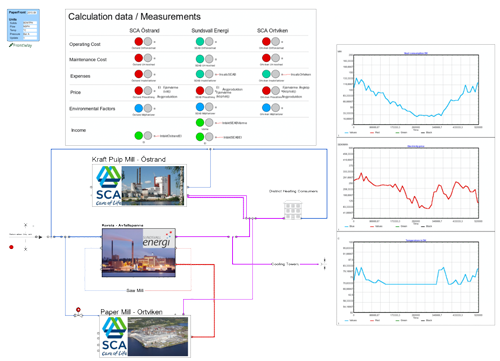

Although there are opportunities to reduce electrical energy demand in unit processes of mechanical pulp-based paper and paperboard production, this may not be financially beneficial. This is generally because energy optimization opportunities connected to reduced refiner electricity demand in mechanical pulping systems also results in less steam available for the drying of the paper. As modern high consistency refiner systems produce approximately one ton of steam for each MWh of electricity when producing one ton of pulp, a reduction in electric energy demand leads to increased fuel demand in steam boilers to compensate for the steam shortage. In this study, the authors investigated what the financial and environmental situation would look like if they were to expand the system border from a paper mill to a larger system consisting of a mechanical pulp-based paper or paperboard mill, a district heating system with an incineration boiler and a chemical pulp mill. Mechanical pulp production has a wood to product yield of >90%, a high electric energy demand to separate woodchips to pulp and is a net producer of heat and steam while chemical pulp-based production has a wood to product yield of 50%, a low electric energy demand and is a net heat and electricity producer due to the combustion of dissolved wood polymers. The aim of this research is to create useful and robust models of how to use excess heat from certain industry sites to cover the steam shortage in other industry sites by means of utilizing and optimizing the district heating systems connecting these sites. For this purpose, the authors used the FrontWay module with ExtendSim which dynamically allows them to evaluate different scenarios. Their results shows that there is great potential to reduce both carbon dioxide emissions and production costs for industry sites and society by means of these tools.

Energy Optimization in a Paper Mill Enabled by a Three-Site Energy Cooperation
- Source: Anders Nilsson & Per Engstrand, FrontWay AB, Norrkoping, Sweden
- Date: Energies, April 2022