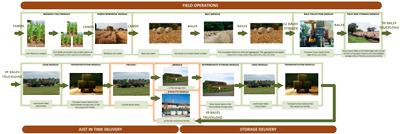

Up until now, most of the models developed to optimize biomass supply chains have failed to quantify the effect of biomass quality and the preprocessing operations required to meet biomass specifications on overall cost and performance. However, the IBSAL-SimMOpt method provides a novel approach for finding near-optimal solutions to the problem of designing biomass supply chains that improve the physical characteristics of the feedstock at an acceptable cost. The bioenergy sector and the research community now have access to a simulation-based optimization model with activity-based costing that is capable of representing the stochastic behavior of some elements intervening in the corn stover supply chain for the production of bioethanol. This analytical model can be used for decision making as well as educational and training purposes since it allows the user to conduct “what if” scenarios.

Development of the IBSAL-SimMOpt Method for the Optimization of Quality in a Corn Stover Supply Chain
- Source: Energies, Volume 10, Issue 8
- Date: August 2017