


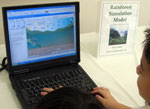
A comprehensive middle school and high school environmental education program coupled with support from the National Science Foundation created an ExtendSim model simulating the effects of rainforest deforestation and agriculture (planting pasture crops) on the amount of CO2 in the atmosphere and on animals living in the rainforest. Hence, the Rainforest Carbon Cycling Model was born.
The Rainforest Carbon Cycling Model makes a tropical rain forest come alive as carbon from the air flows through it! Designed for users with no previous modeling experience, this model allows users to delve into ‘What if?’ sorts of questions about factors that limit forest production and the effects of land-use change on carbon cycling and global warming.
Rainforest Carbon Cycling Model History
Ann Russell, Terrestrial Ecosystems Ecologist at Iowa State University had a dream to develop a model of carbon cycling in a tropical rain forest using ExtendSim energy language model. Using data collected from research in a Costa Rican rainforest, Jim Dailey of Jim Dailey & Associates transformed the data into an animated, bilingual model for children and the general public and called it the Rainforest Carbon Cycling Model.
The model was distributed to 45,000 children in the Miami-Dade County school system through an outreach program organized by the Fairchild Tropical Botanical Gardens in Coral Gables, Florida called the Fairchild Challenge
Fairfield Challenge Overview
Designed for students of diverse interests, abilities, talents and backgrounds, the Fairchild Challenge is Fairchild Tropical Botanic Garden's environmental education outreach program. With separate but parallel programs for different grade levels 6 to 8 and 9 to 12, the Fairchild Challenge is composed of multidisciplinary competitions aligned with Sunshine State Standards.
The annual Fairchild Challenge options are intended to appeal to students' sense of play and creativity, to encourage them to experiment with ideas, projects and skills and to empower them to seek information and voice opinions. This free program was originally open to all schools in the greater Miami area. As of January 2010, 92 middle schools and 61 high schools are actively participating in the Fairfield Challenge. Other sites are replicating the Fairchild Challenge model nationally and abroad.