

When ExtendSim crashes and the issue cannot be reproduced using a model, a crash dump file can help our Support Team diagnose the problem.
What is a crash dump file?
A crash dump file (.dmp) captures the state of ExtendSim at the moment it crashes, including memory and process information. This allows our Simulation Engineers to identify the root cause of the issue.
Why do I need to enable this?
By default, Windows does not create dump files for application crashes. You must enable this feature first.
How to create a crash dump for ExtendSim.
This guide walks you through enabling Windows to automatically create a crash dump file when ExtendSim crashes.
Note: To allow creation of a dump file, you might need elevated permissions to make changes to your device's Registry.
- Open the Registry Editor.
- Press the Windows key + R to open the Run command box.
- Type “regedit” in the Run window and click OK.
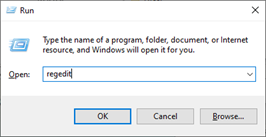
- Click Yes in User Account Control Window pop-up to allow changes.
- Create a LocalDumps key.
- Navigate to the location HKEY_LOCAL_MACHINE\SOFTWARE\Microsoft\Windows\Windows Error Reporting.
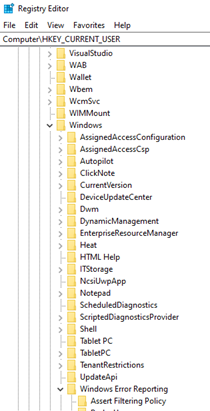
- To create a new key named LocalDumps (you will need elevated privileges):
- Right-click the Windows Error Reporting folder.
- Select New and then Key.
- If a key named LocalDumps is already there, go to the next step. If not, create a new key and name the new key “LocalDumps”
- Set the DumpCount Registry Value:
- If a DumpType value already exists, double-click it and change the Value to 2.
- If there is no DumpType value, create a new one:
- Right-click in the blank area on the right side and select New > DWORD (32-bit) value.
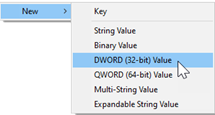
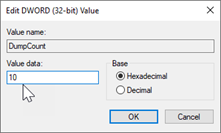
- Name it “DumpCount”.
- Double click it and enter 10 in the Value data field.
- Set the DumpType Registry Value:
- Right click in the blank area on the right side and select New > DWORD (32-bit) value.
- Name it “DumpType”
- Double click it and enter 2 in the Value data field.
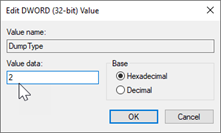
- Navigate to the location HKEY_LOCAL_MACHINE\SOFTWARE\Microsoft\Windows\Windows Error Reporting.
- Close the Registry Editor.
Reproduce the crash.
- Launch ExtendSim
- Run the model that causes the crash.
When ExtendSim crashes, Windows will automatically generate a crash dump file at C:\Users\username\AppData\Local\CrashDumps. The AppData folder is hidden by default. To open the folder, type %LOCALAPPDATA%\CrashDumps in the File Explorer address bar. Compress then send the most recent .dmp file whose name starts with ExtendSim. (Note: Unless you have the proper application installed on your device, you will not be able to open and view this file's contents.)
If ExtendSim freezes instead of crashing, no dump file is created automatically. In that case, open Task Manager, go to the Details tab, right-click the ExtendSim process and choose “Create memory dump file”.
Send the file to ExtendSim Support.
- Create a Support Ticket.
- Provide a brief description of what you were doing when the crash occurred.
- Attach the crash dump file (.dmp) you created for our analysis. A complete dump file can be several hundred MB or more. If it is too large to attach to the ticket, even zipped, let us know and we will send you a link to upload it.
The steps above already create a complete dump of ExtendSim (DumpType = 2), which is what our Support Team needs. You do not need to change any other Windows setting, such as “Complete memory dump” under Startup and Recovery. That setting only applies when the whole computer crashes (blue screen) and does not give us any extra information about ExtendSim.