

The ExtendSim License Manager on the Server requires three unblocked ports:
- 5054 (a web server port) so you can use a browser to communicate locally (on your network) with the License Manager.
- Two TCP ports (5053 and the ISV Server port, which is 51006 by default) must be open for inbound access on the Server. The License Manager uses these ports to receive ExtendSim requests for license information, send an encrypted response over your network, and communicate internally with license management fi les on the Server. (If needed, these ports can be changed as discussed in the FAQ Changing the default port (5053) used for communication between the License Manager and ExtendSim.)
Client devices require two TCP ports (5053 and the ISV Server port, which is 51006 by default) be open for outbound access. ExtendSim uses these ports to request and receive encrypted license information (product, license status and availability, server hostname, etc.) from the Server’s License Manager over your network. (If needed, these ports can be changed as discussed in the FAQ Changing the default port (5053) used for communication between the License Manager and ExtendSim.)
The ports can be opened by configuring the Windows Firewall:
- Open Control Panel > System and Security > Windows Firewall > Advanced Settings.
- Select Inbound Rules and click New Rule.
- Choose Port, click Next.
- Select TCP and Specific local ports, then enter your chosen port number (e.g., 51006).
- Select Allow the connection and click Next.
- Apply the rule to all network types (Domain, Private, Public) and give it a descriptive name (e.g., "ExtendSim Port").
- (Optional but Recommended) Go to the rule's Properties, then the Programs and Services tab, select This program, and browse to your RLM executable (e.g., rlm.exe) to bind the port to the application.
 When an ExtendSim License Manager is activated, a default port (51006) is assigned as the ISV Server port, as shown in the Status command. We recommend unblocking and using this port since it will not change when the Server restarts or the license is reactivated. It is possible to specify a different unblocked port as the permanent ISV port, but you will need to reset it each time the license is reactivated.
To set a different ISV port, use the RLSA window to edit your already-activated extendsim.lic license file:
- Using a browser, open the RLSA window as indicated at Part 2 • Activate License Manager of the separate document Installing & Activating ExtendSim Floating Licenses.
- On the left side of the RLSA window, click the Edit License Files command. (Note: The License File to Edit should be extendsim.lic.)
- In the window that appears, click the Edit License File button.
- In the license file field, change the number for the ISV extendsim port to be the unblocked port you’ve chosen.
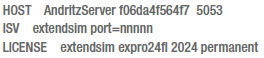 It should now read "ISV extendsim port=nnnnn", where nnnnn is your unblocked port, as shown here:
 - In the RLSA window, click the Update License File button. The window should report license file extendsim.lic written.
- On the left-hand side of the RLSA window, click the Reread/Restart Servers command (this restarts the License Manager, not your Server).
- For the ISV, select extendsim, then click the Reread/Restart button to restart the License Manager.
- If successful, the window will display the message Reread command sent to extendsim. This indicates that the new port will be added as an alternate port.
- Click the Status command on the left side of the RLSA window to verify that the new ISV port is running. If it isn’t listed or isn’t running, and you’ve followed the directions correctly, you will need to restart the Server.
- You do not need to copy the updated extendsim.lic file to each Client, but each Client does need to have that ISV port open for outbound access.
You can edit the license to use a different port than the default port (5053). However, how you do that depends on your situation:
- If you received the extendsim.lic file while doing a manual activation but haven't resumed the activation process, directly change the port number in the file and save that change before proceeding. Then complete the activation procedure. Be sure to give the updated extendsim.lic to each Client.
- If you have already finished the process of activating the License Manager, you must edit your existing extendsim.lic file using the RLSA window.
- Using a browser, open the RLSA window as indicated at Step 2 • Activate License Manager in the document titled Installing & Activating • Floating Licenses.
- On the left side of the RLSA window, click the Edit License Files command. (Note: The License File to Edit should be extendsim.lic.)
- In the window that appears, click the Edit License File button.
- In the license file field, change 5053 (the default port number) to a different number. Note that the new port must be unblocked inbound and outbound for both the License Server and the Client devices.
- Click the Update License File button. The window should report license file extendsim.lic written.
- On the left-hand side of the RLSA window, click the Reread/Restart Servers command.
- For the ISV, select extendsim, then click the Reread/Restart button to restart the License Manager.
- If successful, the window will display the message Reread command sent to extendsim. This indicates that the new port will be added as an alternate port.
- Copy the updated extendsim.lic file to each Client and unblock the new port on Client devices.
Not directly. Before you try to move the License Manager, contact us at Sales.ExtendSim@Andritz.com or call us at 1.408.365.0305. We will revoke the current license so you can activate on the new Server. Then, on the original Server, follow the instructions in Frequently Asked Questions • Floating Licenses to stop the service and remove the service, before you uninstall the License Manager.
ExtendSim and the ExtendSim License Manager are both Windows products. There is no native Linux product.
However, you can run ExtendSim or any Windows product on a Linux server using a compatibility layer such as Wine.